Automation & Integration AI

ClawTeams

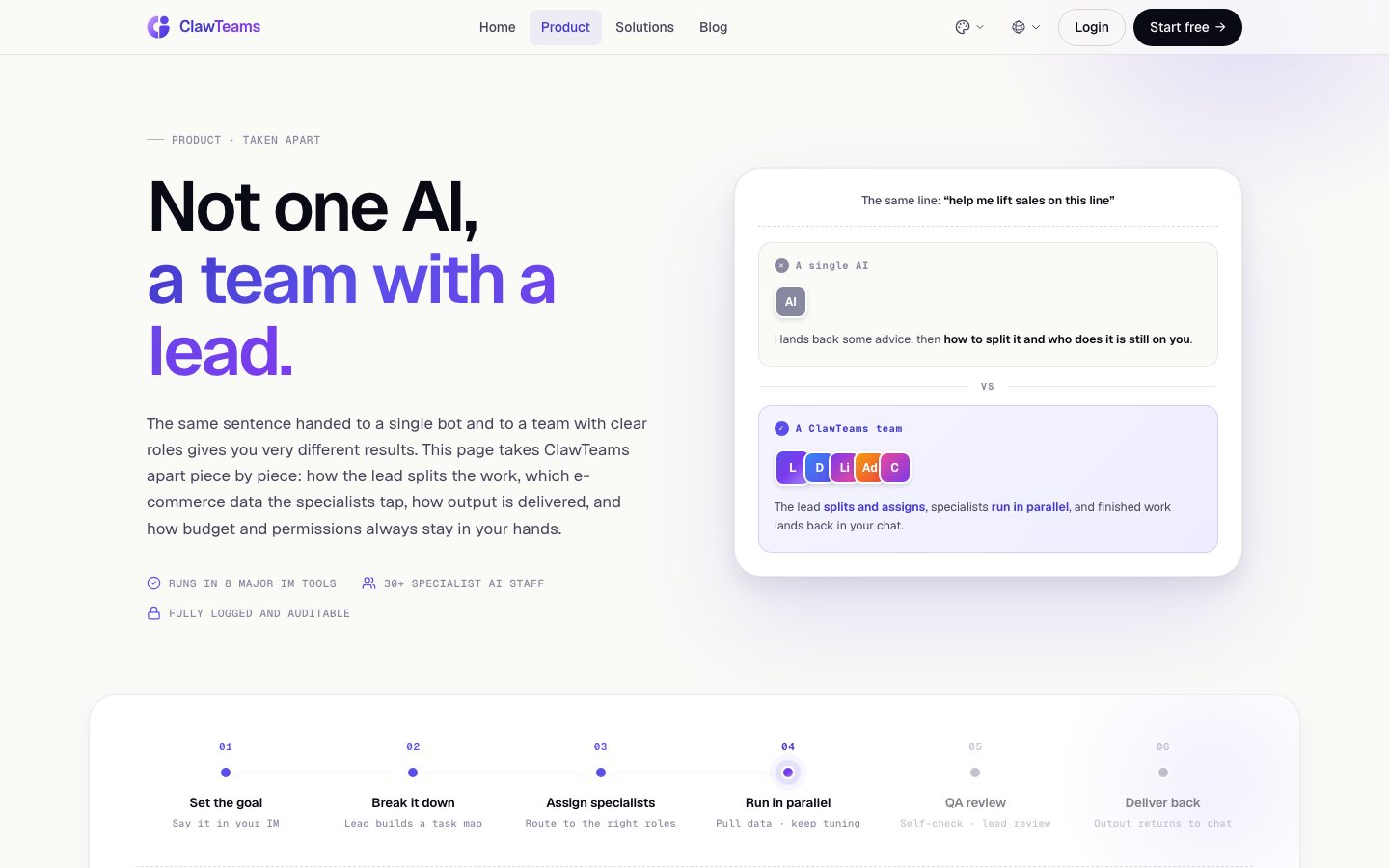
ClawTeams is a managed multi-agent ecommerce operations service for founders and operators who need to split a goal stated in chat into parallel specialist tasks and receive one reviewed deliverable. A team lead maps the work, dispatches specialist agents in parallel, quality-checks their outputs, and returns one deliverable to the conversation. Approval gates keep sensitive store actions under operator control.

Views
0
Uses
0
Favorites
0
Supported Platforms
Amazon · Shopify · eBay
ClawTeams official product page or product image
Official product-page image source

Buying view: Shortlist it when recurring work spans analysis, content and store operations and a team can define permissions, budget and acceptance criteria. Look elsewhere when publicly listed pricing for a self-serve offering or deterministic single-purpose automation is the first requirement.

Capabilities

ClawTeams helps ecommerce teams rewrite listings, prepare content, diagnose store problems, monitor ads and research product opportunities. The merchant sets a goal and constraints; the Team Leader breaks the work into tasks and coordinates relevant specialists, including parallel work where appropriate. The team receives drafts, reports or approval requests in its workplace chat, rather than having to relay every step between separate assistants.

What problem it addresses

Coordinate a cross-functional ecommerce goal without manually briefing and tracking each specialist task.

How people use it

The merchant provides the goal, deadline and acceptance criteria through a supported workplace channel, such as Slack, and authorizes access to the store or advertising data needed for that job. Goals & Todos keeps completed, blocked and decision-pending tasks visible. The merchant can redirect or pause work; reaching a configured spending limit also pauses it. ClawTeams describes retrying after errors with retained context and progress, and returning unresolved blockers to the merchant.

Listing and content production

For a listing rewrite or a content brief, the merchant supplies the product, target audience and expected result. The Team Leader splits the goal and assigns relevant specialists. Listing work starts with keywords and competitors, then produces titles, bullet points, detail copy and A+ structure recommendations. Content work turns selling points and keywords into multiple versions of image copy, product-page copy or short-video scripts, tailored to the product and audience.

Both routes include a quality check before delivery; work below the agreed standard returns for revision. Listing work combines self-checks with Team Leader review and includes keyword-ranking follow-up. Content review checks compliance and tone. The outputs are copy and recommendations, not an automatically published listing or finished video. Sensitive public actions require the merchant’s approval separately from this quality check.

Listing and content productionFor a listing rewrite or a content brief, the merchant supplies the product, target audience and expected result. The Team Leader splits the goal and assigns relevant specialists. Listing work starts with keywords and competitors, then produces titles, bullet points, detail copy and A+ structure recommendations. Content work turns selling points and keywords into multiple versions of image copy, product-page copy or short-video scripts, tailored to the product and audience. Both routes include a quality check before delivery; work below the agreed standard returns for revision. Listing work combines self-checks with Team Leader review and includes keyword-ranking follow-up. Content review checks compliance and tone. The outputs are copy and recommendations, not an automatically published listing or finished video. Sensitive public actions require the merchant’s approval separately from this quality check.ListingContentNo: reviseYesNo: reviseYesStartProduct, audience and goalTeam Leader assigns workRequestedjob?Research keywords andcompetitorsRewrite listing copyQuality checkpassed?Copy and A+ recommendationsTrack keyword rankingsResearch selling points andkeywordsDraft tailored contentversionsQuality checkpassed?Copy and video scriptsEndListing and content productionFor a listing rewrite or a content brief, the merchant supplies the product, target audience and expected result. The Team Leader splits the goal and assigns relevant specialists. Listing work starts with keywords and competitors, then produces titles, bullet points, detail copy and A+ structure recommendations. Content work turns selling points and keywords into multiple versions of image copy, product-page copy or short-video scripts, tailored to the product and audience. Both routes include a quality check before delivery; work below the agreed standard returns for revision. Listing work combines self-checks with Team Leader review and includes keyword-ranking follow-up. Content review checks compliance and tone. The outputs are copy and recommendations, not an automatically published listing or finished video. Sensitive public actions require the merchant’s approval separately from this quality check.ListingContentNo: reviseYesNo: reviseYesStartProduct, audience andgoalTeam Leader assignsworkRequestedjob?Research keywordsand competitorsRewrite listingcopyQuality checkpassed?Copy and A+recommendationsTrack keywordrankingsResearch sellingpoints and keywordsDraft tailoredcontent versionsQuality checkpassed?Copy and videoscriptsEnd
Store diagnosis and ad monitoring

Once the merchant authorizes access to the relevant store backend and ad reports, they can arrange recurring checks. Store diagnosis scans performance, locates anomalies such as ranking declines or rising returns, and assigns a specialist to investigate the cause and propose a fix. Ad monitoring examines ROAS, spend and conversions, identifies inefficient keywords, and prepares bid, keyword and budget recommendations. These are independently arranged monitoring jobs, not consecutive steps.

Diagnosis delivers a brief, assigned issues and a proposed fix for the merchant to review. Advertising changes proceed only after approval; without it, the proposal remains pending, and no change is executed. Price or spending changes must wait for permission. Scheduled Tasks and Meetings can support later checks and priority updates. The end marker closes the illustrated run or handoff, not every unresolved decision or future monitoring cycle.

Store diagnosis and ad monitoringOnce the merchant authorizes access to the relevant store backend and ad reports, they can arrange recurring checks. Store diagnosis scans performance, locates anomalies such as ranking declines or rising returns, and assigns a specialist to investigate the cause and propose a fix. Ad monitoring examines ROAS, spend and conversions, identifies inefficient keywords, and prepares bid, keyword and budget recommendations. These are independently arranged monitoring jobs, not consecutive steps. Diagnosis delivers a brief, assigned issues and a proposed fix for the merchant to review. Advertising changes proceed only after approval; without it, the proposal remains pending, and no change is executed. Price or spending changes must wait for permission. Scheduled Tasks and Meetings can support later checks and priority updates. The end marker closes the illustrated run or handoff, not every unresolved decision or future monitoring cycle.Store checksAd checksYesNot yetStartMonitoring goal and scheduleTeam Leader assigns checksScan store performanceAssign anomaly investigationBrief and fix plan for reviewMonitor ROAS, spend andconversionsIdentify inefficient keywordsAd adjustment proposalMerchantapproved?Execute approved changesPending approval; no changeEndStore diagnosis and ad monitoringOnce the merchant authorizes access to the relevant store backend and ad reports, they can arrange recurring checks. Store diagnosis scans performance, locates anomalies such as ranking declines or rising returns, and assigns a specialist to investigate the cause and propose a fix. Ad monitoring examines ROAS, spend and conversions, identifies inefficient keywords, and prepares bid, keyword and budget recommendations. These are independently arranged monitoring jobs, not consecutive steps. Diagnosis delivers a brief, assigned issues and a proposed fix for the merchant to review. Advertising changes proceed only after approval; without it, the proposal remains pending, and no change is executed. Price or spending changes must wait for permission. Scheduled Tasks and Meetings can support later checks and priority updates. The end marker closes the illustrated run or handoff, not every unresolved decision or future monitoring cycle.Store checksAd checksYesNot yetStartMonitoring goal andscheduleTeam Leader assignschecksScan storeperformanceAssign anomalyinvestigationBrief and fix planfor reviewMonitor ROAS, spendand conversionsIdentifyinefficientkeywordsAd adjustmentproposalMerchantapproved?Execute approvedchangesPending approval;no changeEnd
Product-selection research

The merchant supplies a target category and research criteria, and the Team Leader assigns the research. Specialists examine demand trends, compare competitors’ prices, rankings, reviews and selling points, then assess candidates using costs, margins and competition. The result is a ranked shortlist and research report for the merchant’s product-selection decision.

The report supports a human decision; it does not place purchase orders or guarantee profitability. The public workflow describes the factors used in assessment but does not publish a fixed scoring formula or weights.

Product-selection researchThe merchant supplies a target category and research criteria, and the Team Leader assigns the research. Specialists examine demand trends, compare competitors’ prices, rankings, reviews and selling points, then assess candidates using costs, margins and competition. The result is a ranked shortlist and research report for the merchant’s product-selection decision. The report supports a human decision; it does not place purchase orders or guarantee profitability. The public workflow describes the factors used in assessment but does not publish a fixed scoring formula or weights.StartCategory and researchcriteriaTeam Leader assigns researchResearch demand trendsCompare competing productsAssess costs, margins andcompetitionRanked shortlist and reportMerchant reviews productchoicesEndProduct-selection researchThe merchant supplies a target category and research criteria, and the Team Leader assigns the research. Specialists examine demand trends, compare competitors’ prices, rankings, reviews and selling points, then assess candidates using costs, margins and competition. The result is a ranked shortlist and research report for the merchant’s product-selection decision. The report supports a human decision; it does not place purchase orders or guarantee profitability. The public workflow describes the factors used in assessment but does not publish a fixed scoring formula or weights.StartCategory and researchcriteriaTeam Leader assignsresearchResearch demand trendsCompare competingproductsAssess costs, marginsand competitionRanked shortlist andreportMerchant reviewsproduct choicesEnd

Commercial plans

View official pricing details

ClawTeams offers the first goal free once, then meters work in credits. The public product page does not give a paid subscription amount or a credit-to-currency rate, so task budget caps cannot be converted into a subscription estimate. Confirm credit allowances, purchase rates and renewal terms before paying.

Currently published pricing and purchase terms

Product or sales surfaceScopePublic price and status
First goal

One goal under the current official product-page offer

Included plan entitlements
  • Turns one ecommerce goal into a task map for 30+ specialist roles
  • Runs assigned subtasks in parallel and returns a quality-checked deliverable to chat
  • The homepage marks Slack, Telegram, WeCom, DingTalk and Lark as live. Microsoft Teams, WhatsApp and Discord are marked coming soon there, although the product page groups all eight as live; confirm those three channels with ClawTeams before relying on them.
$0 once
Paid subscription

USD, credits and automatic renewal under the current terms

Included plan entitlements
  • Turns one ecommerce goal into a task map for 30+ specialist roles
  • Runs assigned subtasks in parallel and returns a quality-checked deliverable to chat
  • The homepage marks Slack, Telegram, WeCom, DingTalk and Lark as live. Microsoft Teams, WhatsApp and Discord are marked coming soon there, although the product page groups all eight as live; confirm those three channels with ClawTeams before relying on them.
  • Supports budget caps, sensitive-action approvals and operator review
No numeric public price is currently displayed

Comparable tools: price and workflow

ToolWorkflow differenceOfficial public price reference
Make AI Agents

Choose for visual, app-connected automation when your team wants to build and own the workflow rather than delegate the whole operating goal.

See current Make AI Agents plans
Zapier Agents

Choose for goal-driven agents that act through Zapier connections with a more self-serve configuration model.

See current Zapier Agents plans
n8n AI Agents

Choose when code, self-hosting and detailed workflow control matter more than a managed ecommerce specialist team.

Cloud and self-hosted options
SellerClaw

Choose it for a more store-action-oriented ecommerce agent experience with published plan credits and channel limits.

See current SellerClaw plans
HeiChat

Choose for customer-facing AI shopping and support conversations rather than cross-functional back-office goal delivery.

See current HeiChat plans

Frequently asked questions

Does ClawTeams publish a current numeric price?

The product page says the first goal can be run once for free, but it did not show a table with numeric paid-plan pricing on 2026-09-01. Terms describe a paid USD subscription with credits and renewal after that, so request the current price and credit rules in writing.

Which chat connections are currently presented as available?

The homepage marks Slack, Telegram, WeCom, DingTalk and Lark as live. Microsoft Teams, WhatsApp and Discord are marked coming soon there, although the product page groups all eight as live; confirm those three channels with ClawTeams before relying on them.

What should a first pilot include?

Use one goal that requires only reversible actions, with named inputs, a budget cap, sensitive-action approval, a clear deliverable and one human who can accept, revise or stop the work.

Native connections

SlackSlack ↔ ClawTeams

Team members can mention the ClawTeams lead in a Slack channel to assign work. ClawTeams posts progress and deliverables back to the channel; the listed connection also supports slash commands and sends files to channels and Canvas.

Slack connection
TelegramTelegram ↔ ClawTeams

Members can assign work in a Telegram private chat or group. The bot returns progress and files in the conversation and provides inline action buttons.

Telegram connection
WeComWeCom ↔ ClawTeams

Members can assign work through WeCom groups or private messages. ClawTeams uses WeCom's approval flow and delivers files to WeCom Docs and Drive.

WeCom connection
DingTalkClawTeams → DingTalk

ClawTeams sends messages through DingTalk's work-notification bot. The listed connection also covers DingTalk approvals, documents and smart forms; this does not establish connections to every app in those workflows.

DingTalk connection
LarkClawTeams → Lark

ClawTeams writes results into Lark Base tables and delivers work through group bots, with document collaboration also listed. Separate Anycross workflows do not make their downstream apps native ClawTeams connections.

Lark connection

Sources

User reviews

101 written reviewsChecked Sep 13, 2026

ClawTeams launch discussion. The total includes maker replies; the three comments below are from other participants.

Reda Roqai chaoui

@s_cen To answer your questions, I lose interest when using the tool feels like another job, if I spend more time using the AI than the work then I just stop using it. However, I like what you're solving so I'm wondering if your users noticed that they're saving time by using your product.

Gal Dayan

the approval-boundary answers in this thread are solid, but they're all about controls you set. the risk I don't see addressed is the platform side - Amazon/Shopify etc flag bulk automated listing or pricing changes as suspicious and can suspend a seller account over it, independent of whether the change itself was a good idea. does ClawTeams rate-limit or pace its actions to stay under those platform-level detection thresholds, or is that entirely the seller's problem to monitor?

Syed Noor

The per-action approval controls look well thought through. The harder problem with goal-driven agents is the goal itself: "increase Q4 revenue 20%" can be hit in ways you'd hate — deep discounts that gut margin, or heavier email that lifts this month's revenue and burns the list next quarter. Each step can look low-risk and pass its guardrail while the sum quietly optimizes the wrong thing. Curious whether the Team Lead is measured only against the stated goal, or against guardrail metrics too — a margin floor, a send-frequency cap, brand constraints — so it's steered away from technically-correct-but-bad paths, not just blocked on individual high-stakes actions. That constraint layer feels like where the trust actually lives. Congrats on shipping, Steven.

More reviews on Product Hunt · Launch discussion

Leave a review

Rate every dimension, then share your real experience.

Task effectiveness
Ease of use
Reliability
Workflow and integration fit
Value for money

Content checked: